

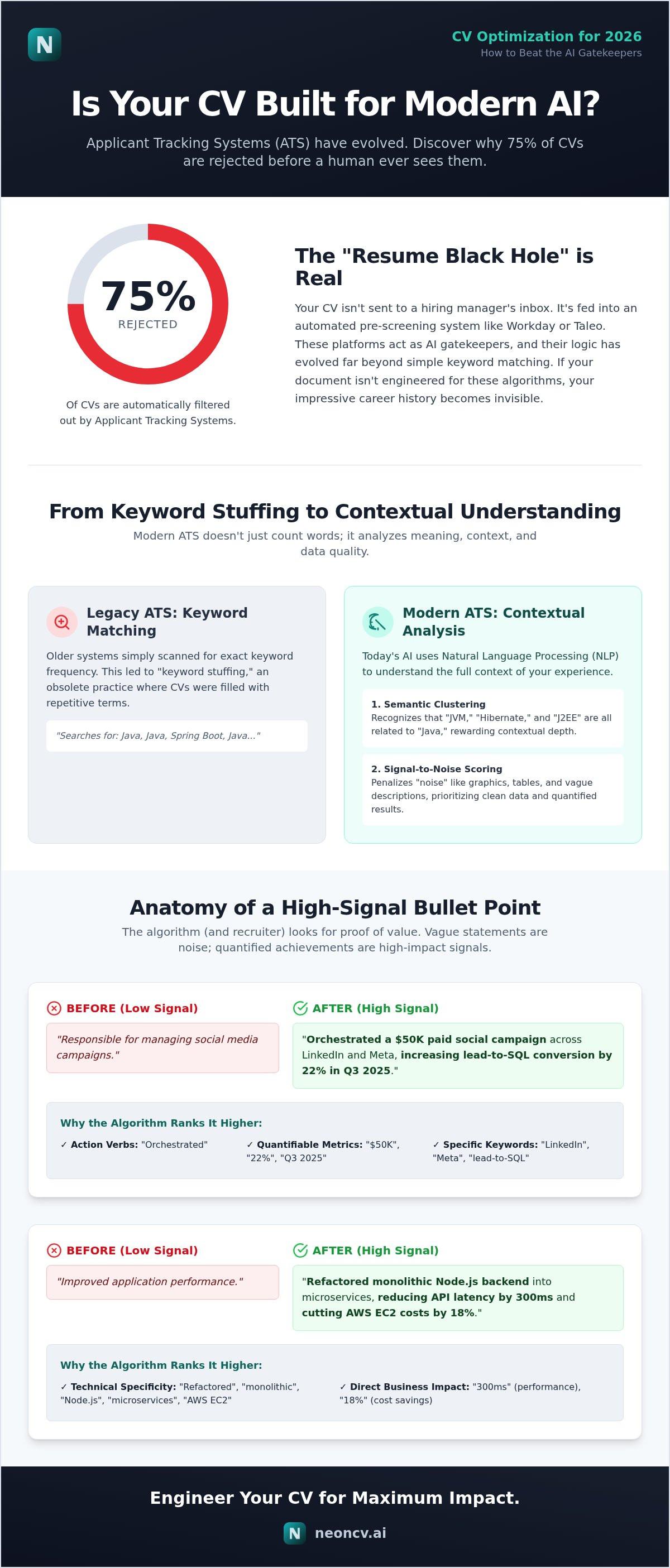
Modern Applicant Tracking Systems (ATS) no longer just scan for keywords; they use semantic clustering and contextual analysis to rank your career data. If your CV isn’t engineered for these algorithms, it’s likely one of the 75% that never reaches a human recruiter.
⚡ Quick Summary & ATS Scorecard Check
- The Problem: Modern ATS like Workday and Taleo use sophisticated semantic parsing, not just keyword matching. Generic or visually complex CVs are systematically down-ranked or discarded.
- The Solution: Your CV must be a clean, machine-readable document engineered with high-signal, quantifiable achievements that align directly with the target job's contextual requirements.
- The Action: Stop guessing if your CV is compliant. Use a purpose-built engine to analyze job descriptions and generate a high-performance, ATS-optimized profile in seconds.
The Modern Recruitment Filter: Why 75% of CVs Disappear
The term "Resume Black Hole" isn't hyperbole; it's the statistical reality of modern, high-volume recruitment. When you submit your application, it isn't routed to a hiring manager's inbox. Instead, it enters an automated pre-screening gauntlet managed by an Applicant Tracking System (ATS). Platforms like Workday, Taleo, and Greenhouse act as the gatekeepers, and their logic has evolved far beyond simple keyword matching.
For high-performance professionals, understanding the technical mechanics of this filter is non-negotiable. Your career history, no matter how impressive, is irrelevant if the machine can't parse, categorize, and score it correctly.
From Keyword Matching to Contextual Vector Embeddings
Legacy ATS operated on a simple principle: keyword frequency. If a job description for a "Senior Software Engineer" mentioned "Java," "Spring Boot," and "Microservices" five times each, the system would scan CVs for those exact terms and rank candidates based on who had the most matches. This led to the now-obsolete practice of "keyword stuffing," where candidates would hide dozens of keywords in white text.
Modern ATS, especially those used in 2026, have rendered this approach useless. They employ a far more sophisticated technology rooted in Natural Language Processing (NLP) and vector embeddings:
- Semantic Clustering: Instead of looking for the exact word "Java," the system understands the entire conceptual cluster around it. It recognizes "JVM," "Hibernate," "Core Java," and "J2EE" as semantically related entities. A CV that demonstrates deep contextual knowledge of the Java ecosystem will outrank one that simply repeats the keyword "Java." -
- Contextual Vector Embeddings: The ATS converts your CV and the job description into complex numerical representations (vectors). It then measures the mathematical distance between these vectors. The closer your CV's vector is to the job description's vector, the higher your "match score." This is why the context in which you present a skill is more important than the skill itself. "Managed a team of Java developers" and "Engineered a low-latency Java-based trading platform" are two vastly different signals. -
- Signal-to-Noise Scoring: Every element on your CV is evaluated for its relevance. Unnecessary graphics, complex table layouts, non-standard fonts, and verbose, unquantified descriptions are considered "noise." The algorithm prioritizes documents with a high signal-to-noise ratio—clean, parsable text that delivers relevant, data-driven accomplishments.
This algorithmic shift means your CV is no longer a document to be read, but a data signal to be processed. Your primary goal is to engineer that signal for maximum compatibility and relevance before a human ever sees it.
The Anatomy of a High-Signal Resume Bullet (Before vs. After)
The most critical signals in your CV are the bullet points describing your accomplishments. This is where the ATS algorithm and, eventually, the human recruiter look for proof of value. A low-signal bullet is vague and passive, while a high-signal bullet is specific, quantified, and aligned with the role's objectives. An advanced AI CV generator doesn't just write text; it engineers these high-signal bullets by mapping your experience to the contextual needs of the job description.
Here is a direct comparison of how LLM resume optimization transforms generic statements into high-impact, algorithm-friendly career signals.
| Weak / Legacy Bullet (Low Signal) | High-Impact / Optimized Bullet (High Signal) | Why the Algorithm Ranks It Higher |
|---|---|---|
| Responsible for managing social media campaigns. | Orchestrated a $50K paid social campaign across LinkedIn and Meta, increasing lead-to-SQL conversion by 22% in Q3 2025. | The algorithm identifies quantifiable metrics ($50K, 22%, Q3 2025), action verbs (Orchestrated), and platform-specific keywords (LinkedIn, Meta). It semantically connects "paid social campaign" to the high-value business outcome "lead-to-SQL conversion." |
| Improved application performance. | Refactored monolithic Node.js backend into microservices, reducing API latency by 300ms and cutting AWS EC2 costs by 18%. | This provides extreme technical specificity. The ATS vectorizes "Refactored," "monolithic," "microservices," "Node.js," and "AWS EC2," creating a strong contextual match for senior engineering roles. The metrics (300ms, 18%) are parsed as direct evidence of impact. |
| Led a sales team to meet targets. | Coached a 12-person enterprise sales team to exceed a $4M ARR target by 15%, implementing a new MEDDIC-based qualification framework. | The system recognizes leadership scale (12-person), financial impact ($4M ARR, 15%), and industry-specific methodologies (MEDDIC). This combination signals not just a sales leader, but a strategic one with a defined process, which is a much stronger signal for executive roles. |
Structural Integrity & Technical Parsing Rules
Even the most perfectly crafted content will fail if the ATS cannot read it. The structural integrity of your CV file is a foundational, and often overlooked, element of compatibility. Visual flair from generic design tools like Canva often introduces "visual noise"—elements that look good to the human eye but break the logical parsing tree an ATS relies on.
To ensure your CV bypasses Workday and Taleo filters, it must adhere to a strict set of technical rules:
- Single-Column Dominance: The most reliable layout is a single, linear column. Multi-column layouts, especially those created with tables or text boxes, can cause the parser to read content out of order (e.g., mixing your job title from column A with dates from column B), corrupting your career timeline. -
- Clean PDF Parse Trees: A properly engineered PDF has a logical content hierarchy, or "parse tree." The ATS reads this structure, not the visual layout. Elements like headers, lists, and paragraphs must be correctly tagged. CVs generated from tools that prioritize visual design over data structure often export flat, untagged PDFs that are nearly unreadable to algorithms. -
- System Font Compatibility: Stick to universal, system-native fonts like Arial, Calibri, Helvetica, or Garamond. Custom or embedded fonts can cause rendering errors in older ATS parsers, replacing your text with unreadable symbols. -
- No Critical Information in Headers/Footers: Some parsers are configured to ignore the header and footer sections of a document. Placing essential contact information like your name, email, or phone number in these areas is a critical error that can lead to your application being discarded as anonymous data. -
- Avoid Images, Icons, and Graphics: Skill-level graphics (like star ratings or progress bars) are unreadable noise. Logos, photos, and other embedded images should be avoided entirely, as they can break the text flow and increase the risk of a parsing failure.
The core principle is function over form. An ATS-optimized CV is an exercise in information engineering, not graphic design. A high-performance AI CV generator automates these structural rules, ensuring your content is delivered to the algorithm with perfect fidelity.
The 5-Step 2026 CV Optimization Checklist
The first 48 hours after a job is posted are the most critical. This is when the highest volume of applications arrives, and the ATS is working overtime to filter the candidate pool. To compete effectively, you need a process that is both precise and incredibly fast. Manual tailoring is no longer a viable strategy.
Follow this checklist to engineer your CV for any target role within minutes, not hours.
- Centralize Your Master Career Data: Before you apply, ensure you have a "source of truth" for your career. This should be a comprehensive document or profile containing all your roles, responsibilities, and—most importantly—a deep list of quantified achievements and project outcomes. This is your raw material.
- Execute Real-Time Job Description Analysis: Copy the full job description or URL of your target role. Use an intelligent tool to parse it instantly, identifying not just keywords but the underlying skill requirements, company values, and desired business outcomes. The system should highlight the most critical "must-have" signals.
- Run Contextual Alignment & Gap Analysis: The AI should cross-reference the job analysis with your master career data. It will automatically select the most relevant achievements from your history and rewrite them to reflect the specific language and priorities of the target role. It should also identify any critical skills gaps between your profile and the job requirements, allowing you to address them in your summary or cover letter.
- Verify Quantifiable Impact: Review the AI-generated bullet points. Is every major statement backed by a number, percentage, or specific, tangible outcome? The algorithm is looking for evidence. Ensure your impact is stated in clear, unambiguous terms (e.g., "Increased revenue by X%," "Reduced costs by $Y," "Improved efficiency by Z hours").
- Export in an ATS-Compliant Format: Generate the final document as a clean, text-based, single-column PDF. Do a final check to ensure there are no complex tables, graphics, or non-standard fonts. This technically flawless document is now ready for submission, engineered to achieve the highest possible score from the ATS.
Engineer Your Career Success
In the automated recruitment landscape of 2026, the most qualified candidate doesn't always win. The candidate with the most algorithmically compatible and contextually aligned CV does.
Treating your CV as a static document is a relic of the past. It is a dynamic data signal that must be precisely engineered for every opportunity. This requires moving beyond manual editing and simple text generators to a system built on contextual intelligence.
NeonCV’s real-time tailoring engine is designed for this reality. It automates the entire optimization checklist, transforming your career history into a high-performance profile that bypasses algorithmic filters and delivers your value directly to recruiters. Stop submitting your experience into the black hole and start engineering your next career move with precision.
Launch your high-performance career with the Neon CV Generator →